
Relative clauses are used to join two sentences together into a more complex sentence and to give extra information about something. We use relative pronouns to introduce the relative clause, they can refer to the subject or object of a sentence.
For example:
- The bicycle that I bought was stolen.
- The man who owns the shop is from Canada.
- My sister, who lives in London, is getting married next week.
In this section we will cover:
- Defining and Non-defining Relative Clauses – definition, examples, features
- Relative Pronouns (who, which, whose, that, whom) and
- Relative Adverbs (when, where, why)
- Prepositions and Relative Clauses
- That/ Which vs what – perhaps the most common error.
1. Defining and Non-Defining Relative Clauses
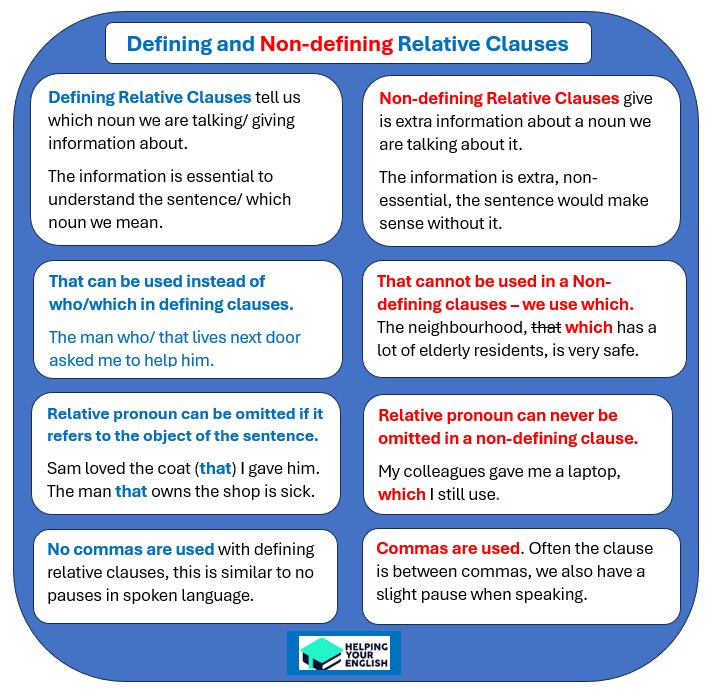
The chart below outlines the main differences between defining and non-defining relative clauses with examples.
2. Relative Pronouns and Adverbs
Relative pronouns include:
- Which – refers to an object.
- Who – refers to a person
- Whom – refers to a person (when the object/ often with a preposition)
- Whose – refers to a person’s possession.
- That – can be used for an object or person, replacing which/ that.
Relative Adverbs or ‘question words’ can replace relative pronouns (+ preposition) to make out speech less formal and sound more natural. They include:
- Where – for a place
- When – for a time
- Why – for a reason.
See the examples below to see how adverbs can replace pronoun (+ preposition).
- I can’t remember the name of the restaurant where we had our party.
- I can’t remember the name of the restaurant that we had out party in.
- I can’t remember the name of the restaurant in which we had our party.
- July is the month when we are busiest.
- July is the month that we are busiest in.
- July is the month in which we are busiest.
- My horrible boss was the reason why I left my job.
- My horrible boss was the reason that I left my job
- My horrible boss was the reason which I left my job.
3. Prepositions and Relative Clauses
We generally use the preposition + pronoun in very formal structures, we can also put the preposition at the end of the sentence, which is less formal.
The most common pronouns that follow a preposition like this are which and whom, though whose can also be used in this way. For example:
- I did a course for which I paid a lot of money. (very formal)
- I did a course which I paid a fortune for. (less formal)
- I did a course that I paid a fortune for. (informal)
- I’m not sure to whom I should send it to. (very formal)
- I’m not sure whom I should send it to. (less formal)
- I’m not sure who I should send it to. (informal)
- He invited the people with whom he works. (very formal)
- He invited the people whom he works with. (less formal)
- He invited the people he works with. (informal)
4. Using what instead of that/ which
One of the most common mistakes people make with relative pronouns is using what when we should use that or which. For example:
- I lost the book
whatthat/ which you gave me. - The things
whatthat/ which you said was very true. - A lot of children bring snacks
whatthat/ which are unhealthy.
Note that in all the sentences above, that or which comes after a noun because it is a (defining) relative clause. We cannot use what as a relative pronoun.
We can use what when it is after a noun, this is often after subject + verb or it can be used at the start of a sentence. For example:
- What I don’t like is how expensive they are.
- I liked what you said in the meeting.
- Everybody thinks what he did was terrible.
- What we should all do now is take a break.