
‘Narrative tenses’ refers to how the following tenses are used to tell a past tense story:
- Past Simple
- Past Continuous
- Past Perfect
- Past Perfect Continuous
Let’s review the main uses and forms for these tenses, which were covered in previous sections. The chart below gives a brief overview of each tense, its form and an example sentence.
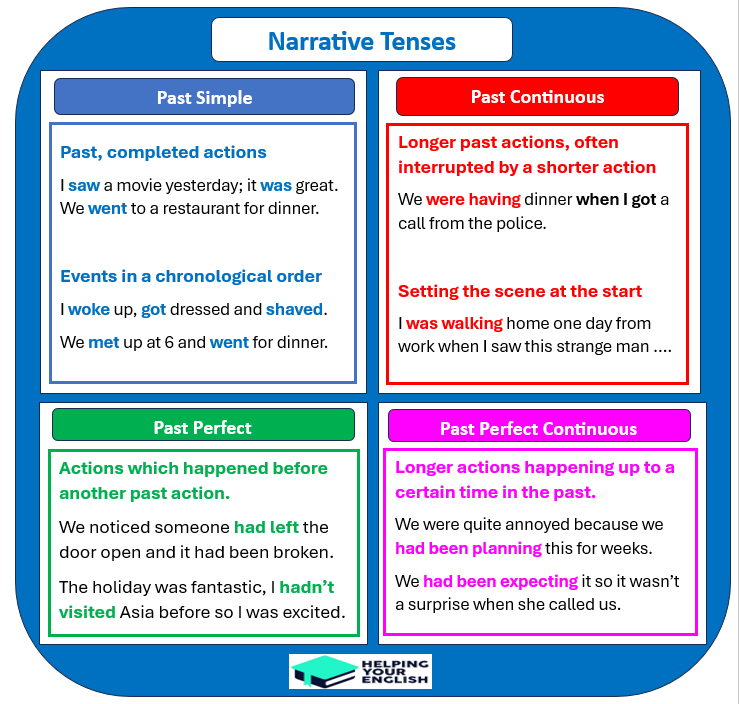
Let’s have a look at a sample story using the guide above to explain the reasons for using each particular tense.
Story One – How I met my friend Patrick.
My friend John and I were walking home from university one night. It was raining quite heavily and getting a little cold. While we were waiting at the bus stop a young man walked by. He was only wearing a t-shirt and shorts so he looked quite strange. He stopped and asked us for directions to a local bar. I asked him why he was wearing shorts and a t-shirt. He explained that he had been and at a pool party earlier and had forgotten his jacket. After we had been waiting for the bus for abut twenty minutes the rain stopped and we decided to walk home. Patrick walked with us and as we were chatting, I realised I had seen him before at university, he was in one of my classes. We decided to meet up the next day and we have been good friends ever since.
Notes
- For the Past Simple, we can see it is the most commonly used tense when telling the stories, it is used for things that happen chronologically – one after the another.
We can also see an example where we must use Past Simple, instead of Past Continuous because the verb is a ‘stative verb’:
He was only wearing a t-shirt and shorts so he was looking quite strange. ⮽
He was only wearing a t-shirt and shorts so he looked quite strange. ✅
- For the Past Continuous, we can see that it occurs at the start of the story several times. It sets the scene, telling us where the people were, what they were doing and what the weather was like.
We can also see that for the third use, ‘…and getting a little cold’, there is no form of the verb to be before ‘getting’, because it is continued from, ‘It was raining heavily’, so we do not need to repeat the verb to be.
- For the Past Perfect, we can see that is much less commonly used compared to Past Simple, only 3 times, whereas Past Simple is used 12 times.
Also, if we look at the three sentences where Past Perfect is used, if we simply use the Past Simple, instead of Past Perfect, there would be no confusion at all.
- He explained he had been/ he was at a party earlier …
- ….. and had forgotten/ forgot his jacket.
- I realised I had seen/ saw him before.
- For the Past Perfect Continuous, we can see that it is a very uncommon tense to use, it occurs only once in the story.
Furthermore, similarly to Past Perfect, if we simply used Past Simple or Past Continuous, the sentence would also sound fine. There would be no confusion.
- After we had been waiting/ were waiting/ waited for the bus for twenty minutes, the rain stopped and decided to walk home.
Finally, we can see that each tense has a specific use for telling past tense stories. If you are unsure which tense to use, it is best to stick with Past Simple because it will usually fit the sentence and not cause any confusion. This is particularly true for Past Perfect and Past Perfect Continuous. It would not replace Past Continuous as easily.