
This tense is used much less often than the Past Simple and Past Continuous to discuss past events, actions and states.
The Past Perfect has a specific function. It is used to describe actions which happened before another past action. See the timeline below.
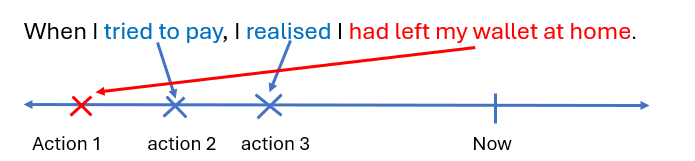
For more detail on how these tenses are used together in a story, see the Narrative Tenses section.
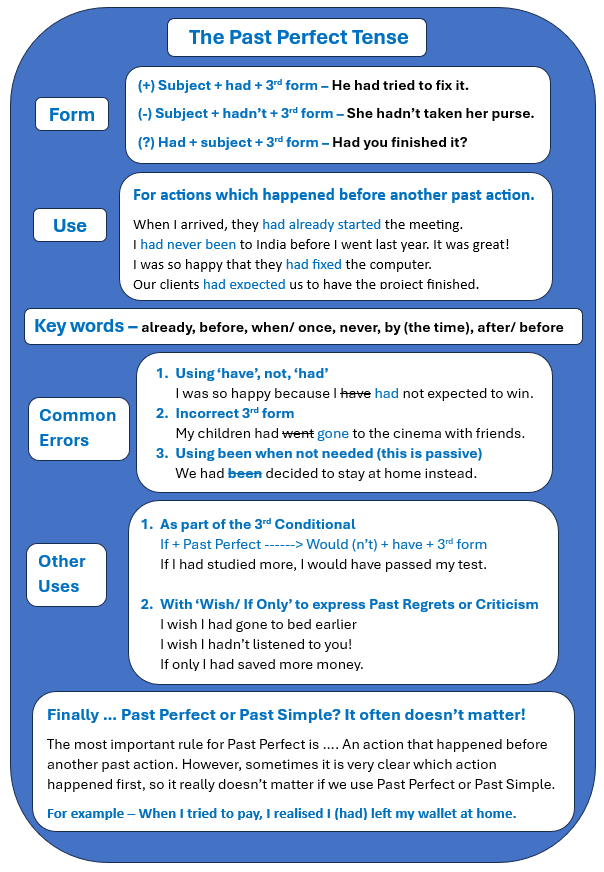
The Past Perfect chart below outlines:
- Form and use with examples.
- Key words and common errors.
- Other uses.
- A note on the Past Perfect and Past Simple
The exercise links will mix these two tenses to show the difference in how we use them for past actions, not the other uses which can be found on those pages.
Other important aspects of the Past Perfect
- We often contract the ‘Subject and had’ part.
The contracted form for each subject is I’d, You’d, He’d, She’d, It’d, We’d, They’d.
It’d is particularly tricky for pronunciation. We can also contract with other subjects such as names when speaking. For example:
- He’d tried to open it but it was locked.
- It’d been years since he had had a full week off.
- Contractions can look like would.
This can be tricky at first, but there is a simple rule to know when a contracted ‘d’ is a ‘had’, or a ‘would’.
Would + base form ……. I’d love to go.
Had + 3rd form …………… I’d forgotten about it.
For more practice with the Past Perfect and how it relates to the other past tenses, see the next section on the ‘Narrative Tenses’.