
The third conditional is different from the First and Second Conditional because it deals with imagined actions and results in the past.
The chart below outlines the form, use and some examples of the Third Conditional. It is followed by some important points about using the third conditional, including:
- Using contractions.
- Alternatives to would.
- Continuous instead of simple.
- The more formal alternative
- Common mistakes.
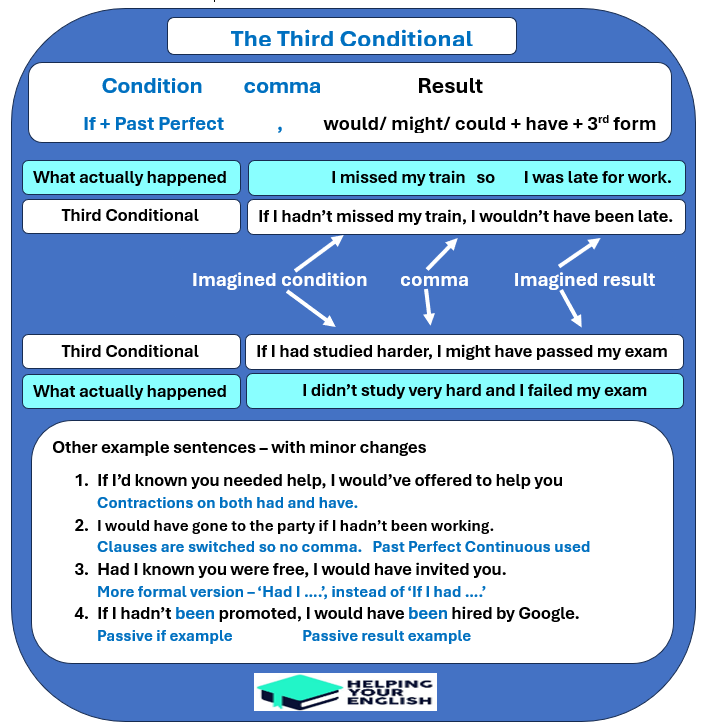
Other Important Points on the Third Conditional
1. Using contractions
Contractions are an important feature of using the Third Conditional. For example:
- If I’d had the chance, I would’ve stayed another day.
- It would’ve been better if you’d been there.
- If he hadn’t made that mistake, he wouldn’t have been fired.
Negative contractions take the same form with hadn’t and wouldn’t. However, Past Perfect can be contracted, particularly if we are using ‘If I had had …..’. We also usually contract the ‘would have’ into ‘would’ve’. This can sometimes be confused with ‘would of’ when writing.
Alternatives to would.
While the usual form is given as ‘would + have + 3rd form’, in reality, would and might are also used to show less certainty. Occasionally, we use ‘may have’ to be more formal, or ‘should have’ for a regret, criticism, or expected result. For example:
- If the flight had been on time, we might have made our connecting flight.
- If our daughter had entered the competition, she could have won.
- If we had known about the event, we may have changed our plans.
- If you hadn’t been trained, you shouldn’t have tried to make the repairs.
3. Continuous instead of simple.
As with the First and Second, we can use a continuous tense instead of the simple tense of it is more appropriate. So, we could use Past Perfect Continuous for longer actions instead of Past Perfect Simple. For example:
- If it hadn’t been raining, we would have had a barbeque.
- I would have gone to the party if I hadn’t been working.
4. The more formal alternative
Instead of using ….. ‘If I had known, ….’, we can use a more formal alternative, using the question form of ‘had + subject (not) + 3rd form. For example:
- Had I known the truth, I would not have helped you.
- Had I understood how bad things were, I would have asked for help.
5. Common mistakes
- Mixing up the form.
As with the other conditionals, the most common mistake I have seen is people (including native speakers!) mixing the result form with the clause form. For example:
If I would have tried harder, I could’ve won. ⮽ If I had tried harder, I could have won. ✅
- Using Past Simple instead of Past Perfect
Students will often use Past Simple in the ‘If Clause’ instead of Past Perfect, or not use the correct third form, using the second form instead. For example:
If I went to college, I would have learned English when I was younger. ⮽
If I had gone to college, I would have learned English when I was younger. ✅
- Writing ‘would of’, instead of ‘would’ve’
This is extremely common, even among native speakers. It is something you often see on comment sections on websites. For example:
I would of helped you if you had asked. ⮽
I would have helped you if you had asked. ✅