
We use certain modal verbs to speculate about events in the past and present. These include:
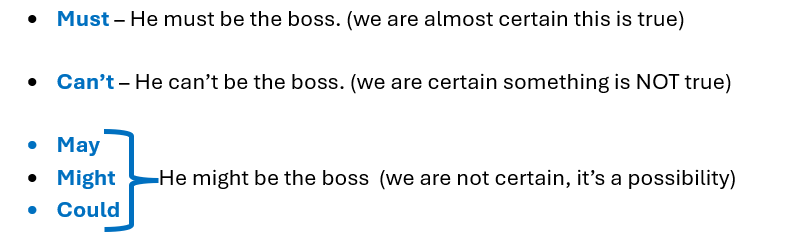
- Should – He should be at home now (this is what we expect to be true)
For negatives we add not, which is usually contracted. For example:
- He mustn’t be at home.
- He mightn’t be at work.
However, we cannot contract may and not, as it is more formal. For example:
He mayn’t be at work yet.⮽- He may not be at work yet. ✅
This form is much less common, it is more formal and also, ‘may not’ is more commonly used for a lack of permission. For example:
- You may not enter this area.
When we use could and not, it has the same meaning as can’t, we are sure that something is not true. For example:
- He can’t be in London; I saw him earlier.
- He couldn’t be in London; I saw him earlier.
Past Modals Verbs of Deduction
When we speculate about things in the past, we use a slightly different structure:
Past modals form
Subject + modal (not) + have + 3rd form
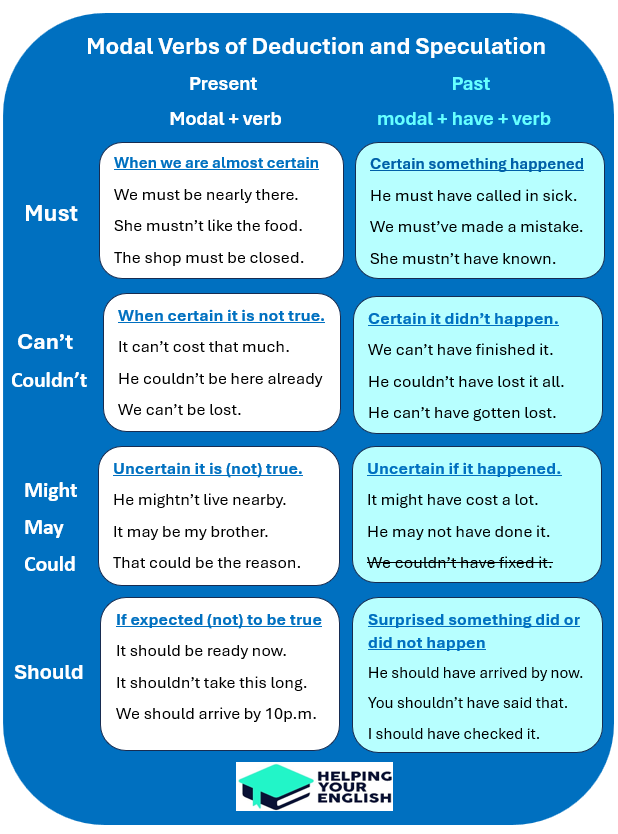
The chart below outlines modal verbs of deduction and speculation in the present and past.
You will notice that the verbs retain the seem meaning, with two exceptions:
- Couldn’t have = it is almost impossible that something happened. (can’t have)
“John couldn’t have broken the computer; he was with me.”
- Shouldn’t have = for criticising someone’s past actions, or expressing regret about our own actions.
“You shouldn’t have said that but I should have warned you.”
NOTE – this is an extra meaning, as we can use “should have” to express about an expectation about a past event. This is more common in a positive than negative sentence. For example:
- He should have arrived by now; I hope everything is okay.
Other Important Point about Modals of Deduction
Using Must not (mustn’t) for a negative deduction.
Technically, we are not supposed to use mustn’t when certain something is untrue. However, it is commonly used. We should use can’t/ couldn’t for negative certainties. For example:
It mustn’t be his car then. Instead – It couldn’t be his car.He mustn’t enjoy doing it.Instead – He can’t enjoy doing it.
2. Using contractions, particularly with Past Modals.
Contractions are very common with modal verbs. In the Present Form we contract for negatives. For example:
- He mustn’t like his job.
- The children mightn’t like pasta.
When we are using Past Modals, it is very common to contract the modal and have:
- It could’ve been his brother that you saw.
- The meal can’t have cost that much money.
When using negatives, we may might contract both the have and the not in a negative sentence when speaking. But we cannot write it this way. For example:
- He couldn’t’ve known that. (How it sounds)
- He couldn’t have known that. (How it is written)
3. Have, can sound like of!
When we contract the have in a positive sentence (or a negative when speaking), the ‘ve can sound like ‘of’. It is a common mistake in writing.
4. Using modal + be + verb-ing
If we are talking about actions happening now, or longer actions, we might use ‘be-verb-ing’, as we do in Present and Past Continuous. For example:
- Their plane should be landing around now.
- He might be trying to eat more healthily.
- He could have been trying to help.