
Ellipsis refers to removing parts of a sentence to avoid repetition. For example:
- They said it will work but I don’t think it will
work. - John opened the door and
hewent inside. - They asked if I wanted to come to the party but I don’t want to
come to the party.
Substitution refers to the replacing of words in a sentence to avoid repetition. For example:
- I bought some sweets; would you like
a sweetone? - He said it’s easy but I don’t think
it is easyso. - We should be able to rent one but if
we can’t rent onenot, I’ll buy one.
Ellipsis and Substitution are very important parts of having a high level of fluency in English because they make communication much more natural and efficient. It is particularly common in speaking and informal writing and is a typical sign of fluency.
The chart below outlines some common examples of both Ellipsis and Substitution. It is divided in to three main sections for both:
Nominal – removing or replacing a noun or noun phrase.
Verbal – removing or replacing a verb or verb phrase.
Clausal – Removing or replacing a full clause.
It is followed by some notes on Ellipsis and Substitution, some sample conversations and practice exercises.
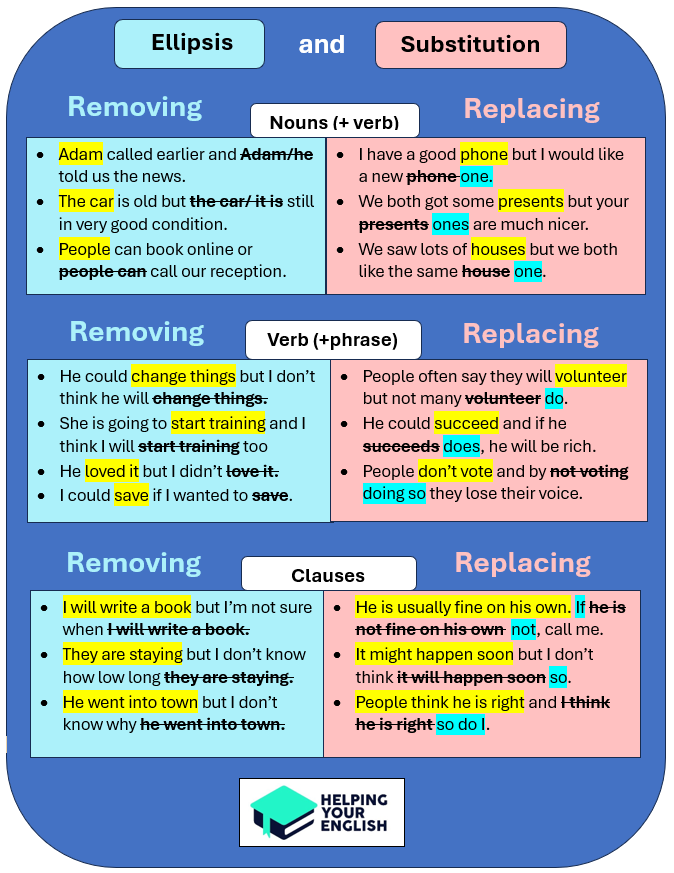
Ellipsis
1. We can also omit an adjective.
Similar to replacing a noun, as in the chart above, we can replace repeated adjectives. For example:
- He thinks it’s fantastic but I don’t think it is fantastic.
- He said it had improved but it hadn’t.
2. They often come after and, but, or.
Generally, we omit the subject after these phrases as it is the same, we can also omit a subject + verb phrase. For example:
- I called my brother and then (I called) my sister.
- We could book a hotel or (we could book) an Air BnB.
3. We can omit the verb or replace it, often if it is a modal verb
- He said he would invest £5,000 but I said I wouldn’t (invest £5,000).
- He said he would invest £5,000 but I said I couldn’t (invest £5,000)
4. We can use Present or Past Auxiliaries
This can be straightforward if the auxiliary is used in the first part of the sentence.
- She didn’t want to go on the boat trip but I did.
Or it can be more difficult when the first part of the sentence is positive and does not use an auxiliary, so we must identify if it is present or past correctly. For example:
- She liked the exhibition but I didn’t (like it/ the exhibition).
- She thinks he’s charming but I don’t (think he’s charming).
This similar to tag questions ….. ‘You don’t like it, do you?’ ‘He’s diabetic, isn’t he?’
Substitution
1. Common Replacing Words
Substitution helps avoid repetition by replacing words or phrases with a shorter alternative. Some common words used for substitution include one(s) for countable nouns, do/does/did for verbs, and that/those for referring to previously mentioned ideas.
For example:
- I prefer the red shoes, but she prefers the blue ones. (Replacing “shoes”)
- He promised to help, and he did. (Replacing “helped”)
- I like his suggestion more than that of his colleague. (Replacing “his colleague’s suggestion”)
2. Common Verbs with ‘So’
“So” can be used as a substitute for entire clauses, particularly after certain verbs that indicate thinking, believing, or expecting. This avoids unnecessary repetition.
Common verbs that are followed by so include: think, believe, expect, hope, say, suppose, assume, guess, and imagine.
For example:
- A: “Will she come to the party?”
B: “I think so.” (Instead of “I think she will come to the party.”) - A: “Are they happy with the decision?”
B: “I hope so.” (Instead of “I hope they are happy with the decision.”) - A: “Did he say he would join us?”
B: “He said so.” (Instead of “He said he would join us.”)
3. ‘So’ and ‘Neither’
We use so and neither/nor to show agreement with positive and negative statements.
- So is used to agree with positive statements.
- Neither/Nor is used to agree with negative statements.
- In both cases, we invert the auxiliary verb and omit the repeated phrase.
For example:
- A: “I love coffee.”
B: “So do I.” (Instead of “I love coffee too.”) - A: “She’s going to the concert.”
B: “So am I.” (Instead of “I’m going to the concert too.”) - A: “I don’t like spicy food.”
B: “Neither do I.” (Instead of “I don’t like spicy food either.”) - A: “He hasn’t finished the report yet.”
B: “Nor have I.” (Instead of “I haven’t finished it either.”)
This structure is also similar to tag questions and can be useful in spoken English to sound more natural.
Sample Conversation
Conversation: Planning a Trip
Emily: So, have you decided where you want to go on holiday this year?
Jake: Yeah, I really want to visit Italy, but Sarah doesn’t (want to visit Italy).
Emily: Oh really? Where does she want to go?
Jake: Spain. She said she loved Barcelona when she visited last year, but I’m not sure I would (love it as much).
Emily: I’ve never been, but my brother has (been there), and he said it was amazing. It’s supposed be a beautiful city.
Jake: Yeah, I suppose so (that it is amazing/ beautiful). But I think I’d prefer somewhere quieter.
Emily: Yeah, I get that. A beach holiday?
Jake: Maybe. We could book a quiet resort, or (we could book) a small Airbnb near the coast.
Emily: I’d go for the Airbnb. I think it’s more relaxing.
Jake: Yeah, I might (go for that option). I still have to check flights. Have you planned anything?
Emily: Not yet, but I should (plan something soon). My parents said I should visit them, so I probably will (visit them).
Jake: That makes sense. You haven’t seen them for a while, have you (seen them)?
Emily: No, I haven’t, and neither has my sister (seen them).
Jake: Well, I hope you find something good!
Emily: You too! Let me know what you decide