
The gerund form is verb-ing ……… eating, going, doing, thinking.
There are two types of infinitive form:
- To + verb ……. To eat, to go, to do, to think.
- ‘Base’ form or the ‘bare’ infinitive, just the verb …. Eat, go, do, think.
This section will look at how/ when these verb forms are typically used. See the chart below which explains the most common ways we use these verb forms:
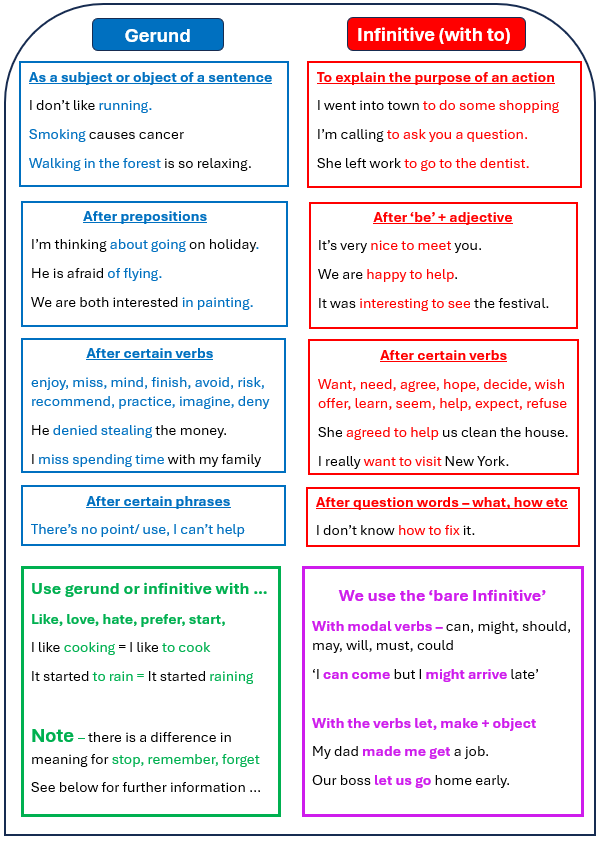
Notes on using the Gerund Form (going)
- The gerund as subject and object of the sentence
A gerund (verb-ing) is a noun, and so can be a subject or object in a sentence.
When we use the gerund as the subject, they can also be ‘gerund phrases’.
For example:
- Walking is good for your health.
- Walking every evening is good for your health.
In the second sentence the subject is more specific, but remains the subject of the sentence and becomes a ‘gerund phrase’.
- The negative for of the gerund is ….. not + verb-ing. For example:
- I regret not travelling more when I was younger.
- I like not going out every weekend.
- I recommend not spending too much time online.
Notes on using the Infinitive with to (to go)
In addition to the uses listed in the chart, there are some others which are useful to know, including:
- We often use the infinitive with to after some/ any/ no + one, thing, where.
- I don’t have anything to wear.
- There’s nothing to eat in the fridge.
- I need someone to help me with this.
- With superlatives (the best) and ordinal numbers (first, second, last) + object
- I think it’s the best thing to do.
- He was the first person to finish the task.
- It’s one of the best places to visit in Italy.
Notes on using the Infinitive for without to (go)
- We also use the ‘base form’ of the verb after auxiliaries in the present and past tenses, after do/ does and did/ didn’t for negatives and questions. For example:
- I didn’t go to the party.
- Does he take the bus to school?
- Did you finish the report?
- I don’t know the answer.
- Sometimes we can use the ‘bare’ infinitive or with to, particularly after verbs like help. For example:
- My father helped me to get into university.
- My father helped me get into university.
Notes on differences in meaning – stop, remember, forget
As noted above, with some verbs there is no difference in meaning if we use the gerund or the infinitive form of the verb. For example:
- I like cycling = I like to cycle.
- I love cooking for my family = I love to cook for my family.
- It started snowing = It started to snow.
Note – some would say there is a difference in meaning between ‘I like to cook’ and ‘I like cooking’, but I disagree. In everyday use, there is no difference.
However, with some verbs, there is a difference in meaning. As noted above, stop is one of the most important verbs, as the meaning is very different:
- I stopped smoking (I quit/ gave up smoking)
- I stopped to smoke (I took a break from what I was doing, to smoke)
Other verbs with a difference in meaning include:
Forget/ Remember
- I forget putting it in the bin (it happened, but I don’t remember doing it)
- I forget to put it in the bin (I often do not remember to put it in the bin)
Regret
- I regret going to university (it was a mistake; I wish it hadn’t happened)
- I regret to inform you that …. (used for giving bad news to someone)
Finally, gerund and infinitive use is a tricky grammar point in English. However, if you follow the basic guidelines in the chart above and pay attention to how they are used when you hear them used and when you read them in texts, it will help. As with everything, practice makes perfect! I hope the exercises below help.