
Reported speech refers to how we describe what other people said. For example:
- He said that he wasn’t feeling well.
- He told me that he was going to the doctor.
- He asked me to remind him about the appointment.
This section will cover the following points:
- The three main verbs – said, told, asked.
- Reported Speech – Switching back a tense.
- Other changes – pronouns and time words.
- When we change tense and when we don’t.
- Common mistakes.
1. Said, told, asked.
We report what people said through three main verbs, said, told and asked.
With these verbs there are some important patterns to remember.
The chart below outlines the form used for said, told and asked with examples:
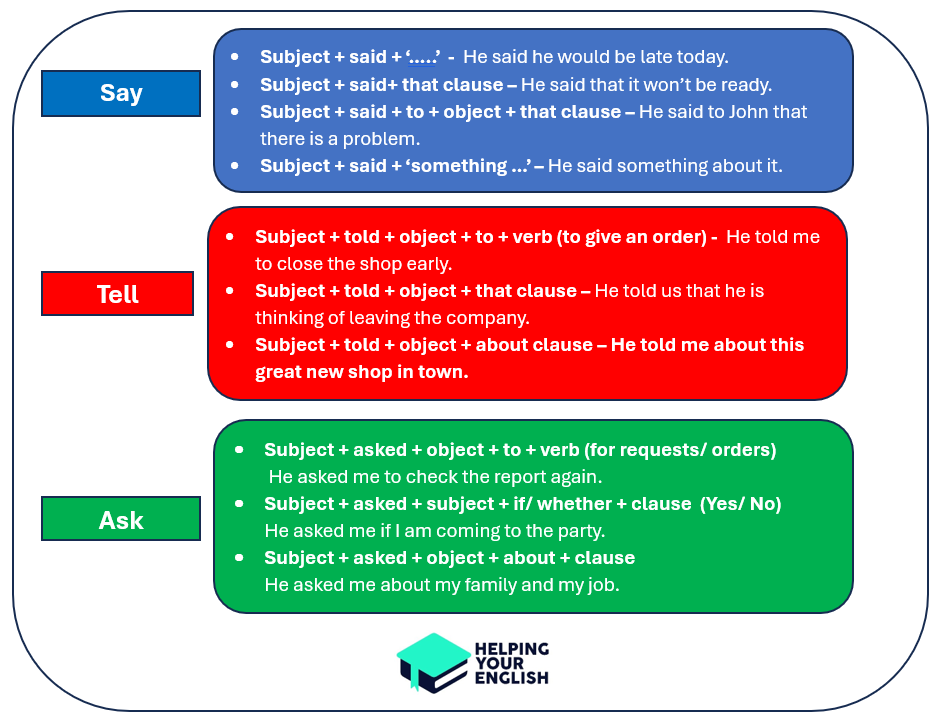
Reported Speech Patterns – Switching to a past form
When we are reporting what people said, we generally change what they said into a past form of the tense or verb. The chart below outlines the general tense changes we make. As you read the chart, ask yourself a question:
Q. If I was reporting what this person said later, would the information still be true.
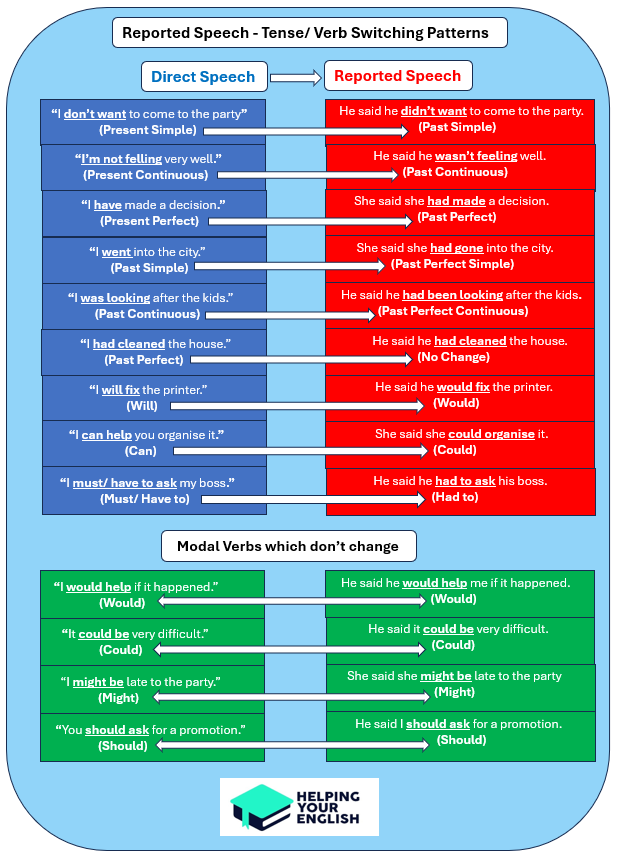
Other changes we make when reporting speech.
1. Omitting that
Have a look at the sentences from the chart above, in each one we could also use that to report what someone said:
- He said (that) he didn’t want to come to the party.
- He said (that) he wasn’t feeling well.
- She said (that) she had made a decision.
2. Changing Pronouns
Look at the following sentences and the changes which are made in pronouns:
- Speaker: “I need you to lend me your car.”
- Person 2: He said he needed me to lend him my car.
- Speaker: “Can you call my parents.”
- Person 2: She asked me to call her parents.
In the sentences we can see the speaker uses first person pronouns (I, me, my) to talk about him/herself and the other person in the second person (you, your), while Person 2 uses first person pronouns about him/herself and third person (he/her, his/her) to talk about Speaker.
3. Changing Time Words
When reporting what people said, we often have to change time words they used. Look at the following sentences for some examples:
- I’m working tonight, I’ll call you tomorrow. (Wednesday)
He said he was working last night but he would call me today. (Thursday)
- My friend is here, he arrived yesterday. (Wednesday)
- He said his friend was there, he said he had arrived the day before. (Thursday)
In each of the sentences above, the time has changed and so the time word used also changes. Other phrases used when reporting include (that day, that night, then).
4. When we change tense and when we don’t.
When we are reporting information which is still true, or has to happened yet, we do not need to change back to a past tense or verb form. For example:
- I don’t own a car 🡪 He said he doesn’t own a car.
- I am going on holidays on Friday. 🡪 He said he is going on holidays.
- I can’t swim well. 🡪 He told me can’t swim well.
- My boss has to sign it. 🡪 He told me his boss has to sign it.
- Your house is beautiful. 🡪 He said my house is beautiful.
In all these sentences, the information is still true, so there is no need to change tense.
NOTE – Something I always tell my students is that, although the tense switches are recommended, correct English, you may often hear people not switching tense when it is appropriate. However, time and pronoun changes must be made.
5. Common errors
The most common errors in relation to Direct Speech refer to the use of said, told, and asked. Their form is simple, but often used incorrectly. For example:
He said me I was correct. ⮽ He said I was correct. ✅He told to me that he will try. ⮽ He told me that he will try. ✅He asked to me what happened.⮽ He asked me what happened? ✅He asked to me why I am tired?⮽ He asked (me) why am I leaving? ✅
Other main errors refer to changes mentioned above – tense changes, pronoun changes and time/ location changes.