
As covered in the Reported Speech section, the most common verbs used for reporting what someone said are say (said), tell (told) and ask (asked.
However, we can use a wide variety of other verbs to more accurately describe what the person said. For example:
- “I can help you if you like?”
- He said he could help me.
- He offered to help me.
- “I’m sorry for damaging your car,”
- He said he was sorry for damaging my car.
- He apologised for damaging my car.
In each of the examples above, the verb more accurately describes what the person said in terms of the purpose of what they wanted to communicate.
Reporting verbs like this are very common in reporting speech and they are in the b2/c1 section for the following reason:
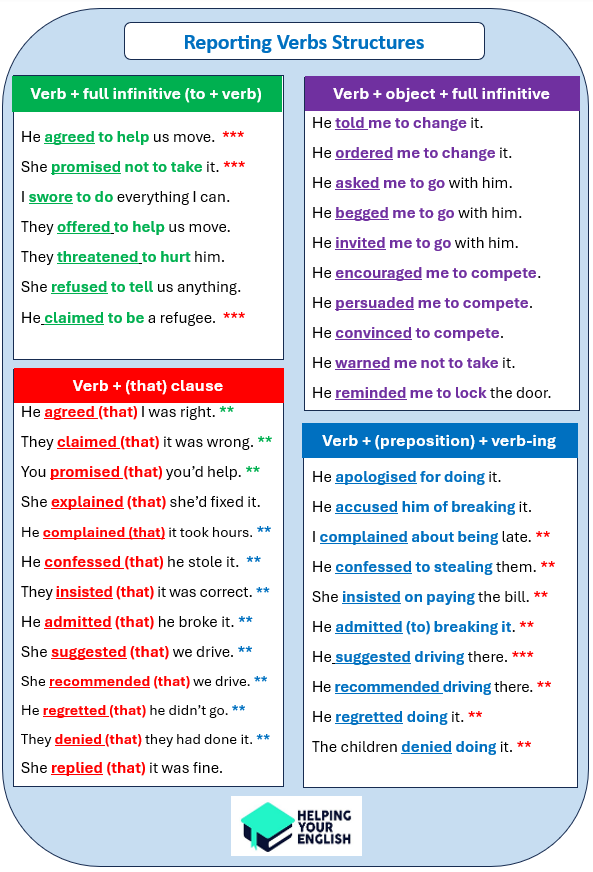
They follow (3) particular patterns, which are:
- Verb + Full infinitive (to + verb) – He promised to help me.
- Verb + object + full infinitive – He warned everyone that the road was dangerous.
- Verb + preposition + noun/verb-ing – He complained about the hotel, staying there.
We also use a verb + ‘(that) clause’ structure. Many of the verbs in structures 1, 2 and 3 can be said using this structure, and some verbs only take this structure, for example ‘explain’
- “I was trying to call but I was actually given the wrong number.”
- He said that he had been trying to call but he had been given the wrong number.
- He explained that he had been trying to call but he’d been given the wrong number.
The chart below outlines the main verbs we use to report what people said. Verbs with a very similar meaning are grouped together and have the same sentence.
It is followed by some other small points on using reporting verbs. Including:
- The(over)use of like in modern reported speech.
- Verb + (that) clause followed by the base form of the verb.
- Verb-ing patterns being replaced by Perfect Gerund (having + 3rd form)
Other Notes:
1. The (over)use of ‘like’ in modern reported speech.
Nowadays, most people in everyday speaking will report what was said by using ‘like’, for example:
- He was like, ‘what did you that for?’ And I was like, ‘’it was your fault!
Turn on any TV chat show or interview and you will no doubt hear this structure. It is more common with younger people and it can also be used as a filler, meaning nothing, or to make comparisons.
2. Verb + (that) clause followed by verb, not Present Simple
In more formal structures, verbs that take the ‘verb + (that) clause can be followed by the base form. This only matters with he/ she/ it because these have different forms. For example:
- I suggested that he take the offer immediately.
- I recommended she speak to a solicitor.
- They insisted that she report it to the police.
- The doctor advised that David be kept in hospital.
3. Perfect Gerund (having + 3rd form) replacing verb-ing
Another formal structure for reporting speech is the use of the Perfect Gerund instead of verb. For example:
- He admitted stealing the money
He admitted having stolen the money.
- He regretted telling his boss.
- He regretted having told his boss.